Waste Slurry Drying
SUNKAIER offers specialized, heavy-duty engineering solutions to tackle the difficulties of drying, solvent recovery, and processing for highly viscous, sticky, and paste-like slurries in the petrochemical, chemical, and pharmaceutical industries. Our technology focuses on managing phase changes from viscous liquid to dry powder, preventing fouling, and optimizing heat transfer.
Technical data
he drying of chemical slurry tar—the heavy distillation residue from TDI production—is primarily achieved through thermal separation processes designed to recover residual TDI and convert the waste into a stable, granular solid. The leading industry standard is the kneader process, which uses specialized, continuously operating twin-shaft reactors.
1. Feed Preparation
- Source: The feed consists of residue from the bottom of the TDI concentration column (typically 30–70% free TDI).
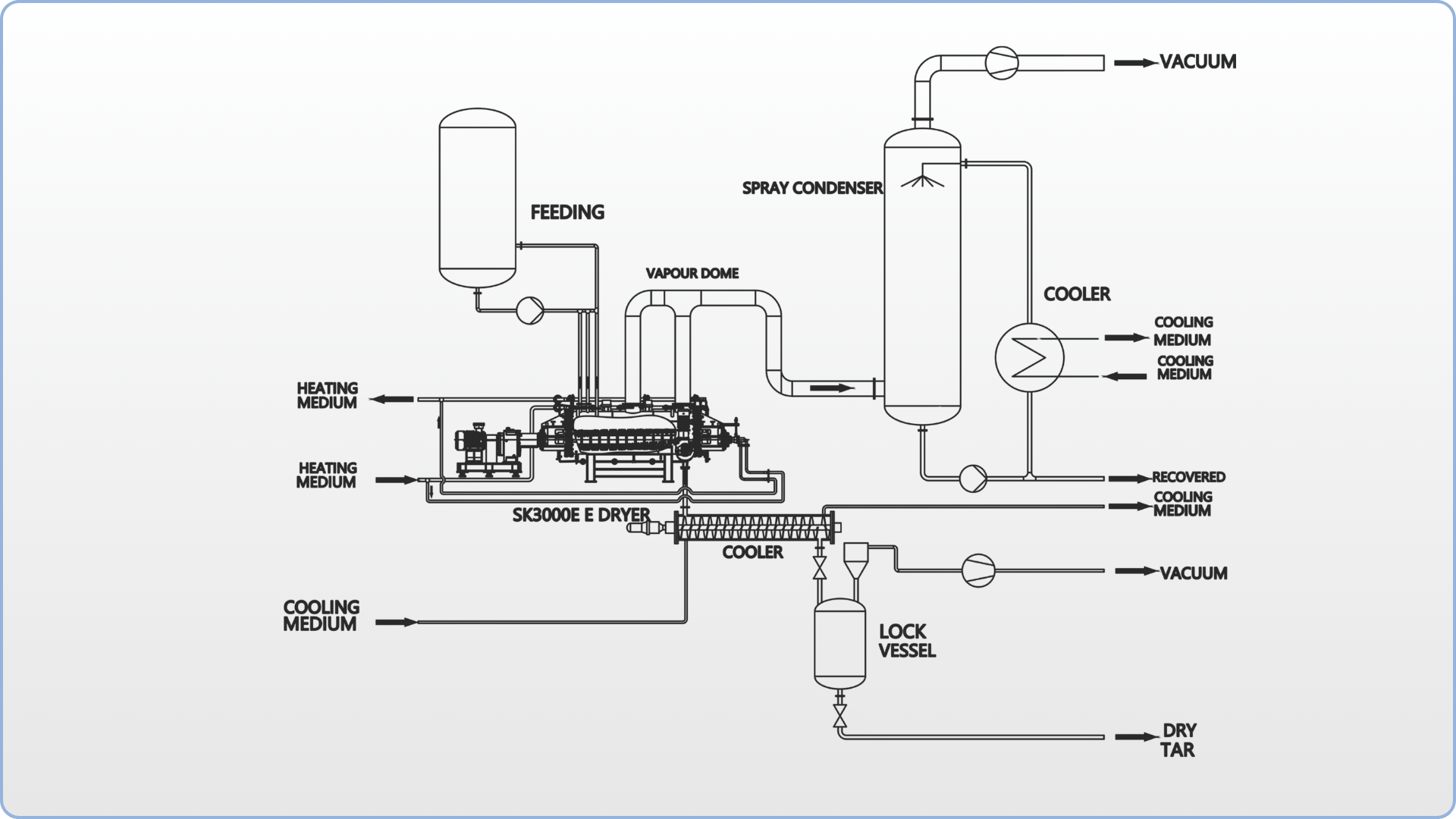
- Handling: The viscous tar is fed into a SK3000E Twin Shaft Processor, designed to handle extreme phase changes from liquid to sticky/viscous to solid, without clogging.
2. Thermal Drying & Evaporation (Under Vacuum)
- Operating Conditions: The process operates under vacuum (e.g., 12 mm Hg) and at high temperatures (e.g., up to 215°C or higher).
- Mechanism: The processor's high-torque shafts provide intense agitation, surface renewal, and mixing. This ensures maximum TDI evaporation (recovery) and prevents the tar from fouling the machine as it goes through a rubbery, viscous, and foaming phase.
- Gas Handling: The volatilized TDI is condensed and recovered for reuse.
3. Solidification and Granulation
- Phase Transition: As the TDI concentration drops below 15%, the material changes from a viscous, sticky paste into a hard, brittle solid.
- Granulation: The continuous mechanical action breaks this solid crust into a fine, granular, and dry powder.
- End Product: The resulting material is an odorless, non-toxic solid with a residual TDI content of less than 0.5 wt%.
Performance data
Main advantages
- High Recovery: Near 100% of the TDI can be recovered.
- Reduced Waste: Converts hazardous tar into a stable solid suitable for disposal or incineration.
- Continuous Operation: Efficient, low-labor, and low-energy compared to batch methods.
Related industries
Explore industries related to this category.