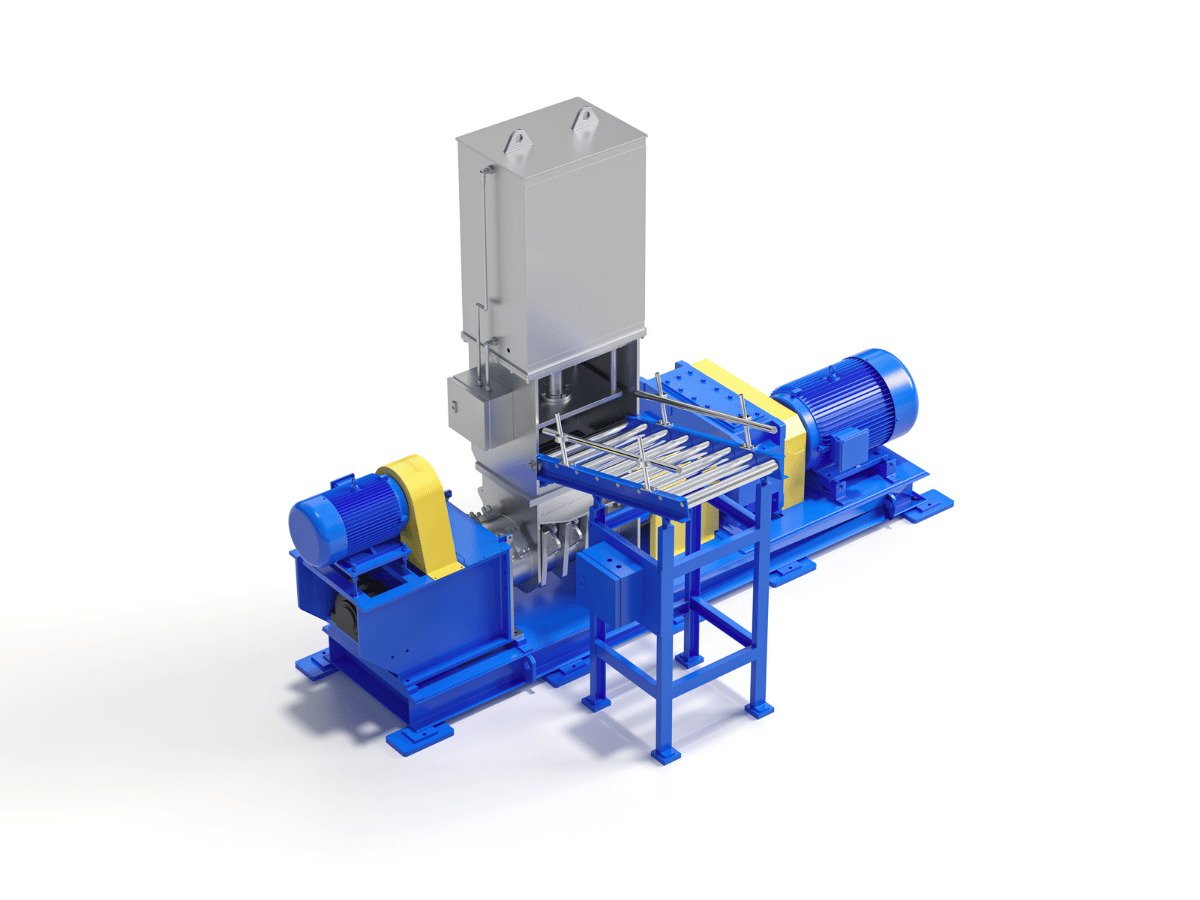
Rubber Chopper
SUNKAIER Rubber Chopper is a specialized, industrial-grade, low-speed, high-torque machine designed to reduce bales of natural and synthetic rubber into smaller particles or crumbs. It is often used in recycling applications to improve downsteam processing efficiency for ABS, HIPS, etc.
Design and working principle
Mechanical Process and Size Reduction
The system transforms raw rubber bales (typically around 35kg) into crumbs ranging from 0.5 to 1.5 inches (1.2 to 3.8 cm) through a sequential four-step process:
- Feeding and Grabbing: Bales enter a feed hopper via gravity or an optional pneumatic ram feeder for difficult materials. They land on a horizontal rotating shaft equipped with claw-like hammers.
- Shearing and Crushing: As the shaft rotates at a low speed (typically 10–40 RPM), the hammers pull the bale into a cutting zone. The rubber is sheared as it passes between the rotating hammers and stationary or adjustable anvils mounted to the machine body.
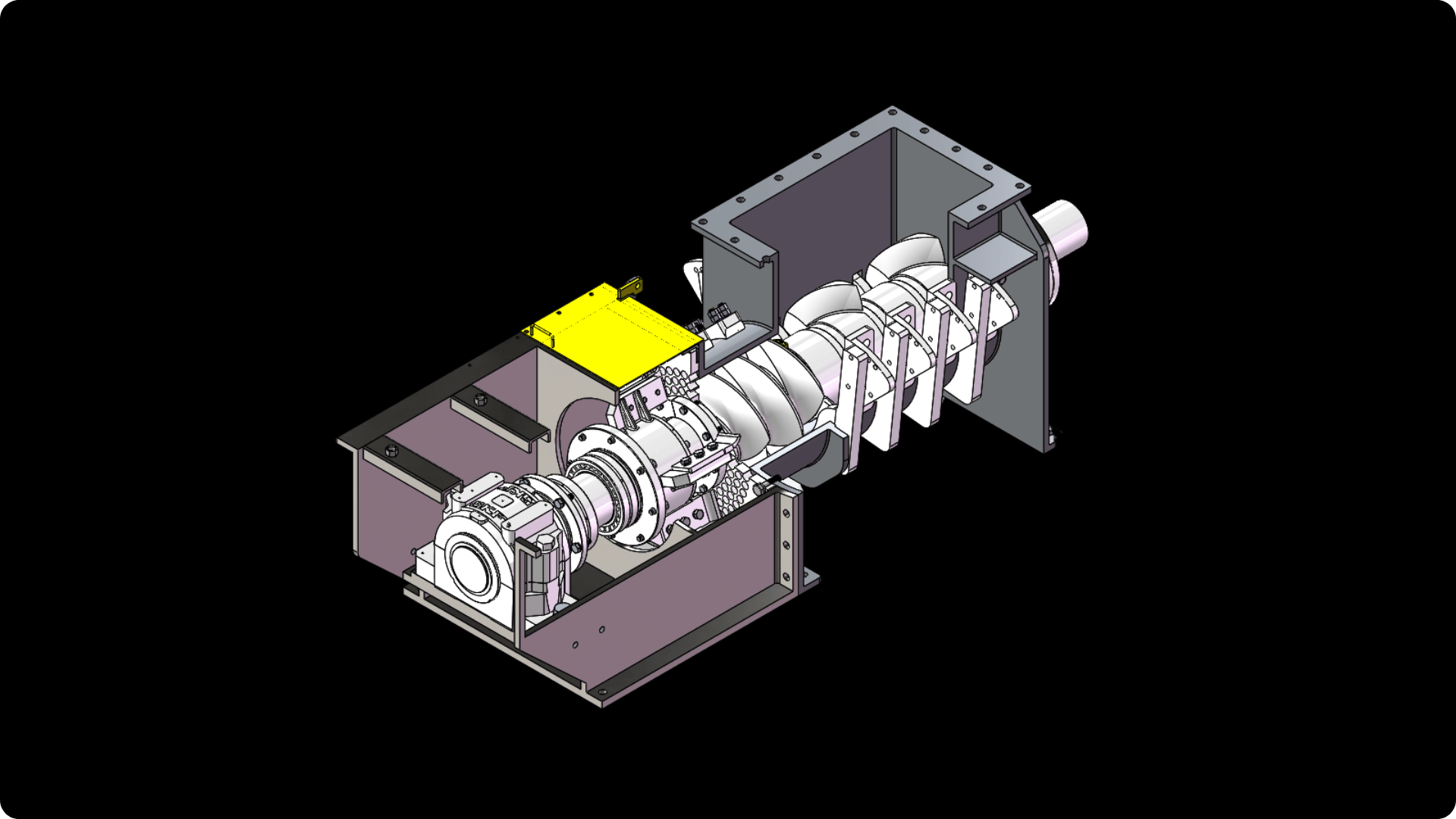
- Extrusion: The screw-type action of the rotor continuously pushes the sheared material toward the discharge end. Here, the rubber is forced through a specialized orifice plate (also known as a spoke plate).
- Final Cutting: As the rubber extrudes through the plate, a cutoff knife assembly (often powered by a separate motor) shears it into its final granule size.
Core Technical Principles
- Low-Speed, High-Torque Operation: By operating at low rotational speeds, the machine generates massive grinding power while minimizing heat generation. This is critical for rubber processing, as it prevents the material from melting or degrading before it reaches downstream dissolution or mixing stages.
- Energy and Output Control: The adjustable anvils allow operators to control the amount of energy imparted on the rubber bale. Changing the anvil position or the orifice plate size enables precise control over the final particle size.
- Additive Integration: To prevent the freshly chopped rubber from re-agglomerating (sticking together), dosing equipment can be integrated to apply anti-sticking agents like talc directly in the grinding chamber or at the discharge.
Design Specifications
- Materials: Constructed from heavy-duty materials such as stainless steel, normal steel, or duplex alloy for corrosion resistance and durability in demanding environments.
- Throughput: Systems can typically process between 1.2 and 6 tonnes per hour.
- Safety: Standard versions are often ATEX-certified for use in hazardous areas where solvents may be present.
Technical data
- Purpose: Specifically designed for grinding/shredding blocks of rubber, plastics, and adhesives.
- Design: Features a heavy-duty construction, typically with a horizontal shaft hammer mill or knife-edge rotor for shearing.
- Performance: Operates at low speeds but high torque to minimize heat input, which prevents premature degradation of the material.
- Downstream Benefits: Reduces bale size to improve melting or cooking efficiency, thereby lowering utility costs and increasing throughput.
- Configurations: Often customized for specific applications, with options for different rotor types and sizing screens.
- These machines are used in various industries, including those handling polymers and synthetic materials, to prepare raw materials for further processing.
Specification
| Model | Rotor | Feed Size | Body length | Kw | RPM up to | Bale Size | Width | Length | Thick | Weight |
| mm | mm | mm | mm | mm | mm | Kg | ||||
| RB380 | 380 | 380×560 | 710 | 110 | 50 | RB380 | 380 | 700-750 | 150-180 | to 35kg |
| RB610 | 610 | 610x840 | 1040 | 375 | 50 | RB610 | 610 | 700-1000 | 150-300 | to 125kg |
video
Related products
Explore products related to this product category.