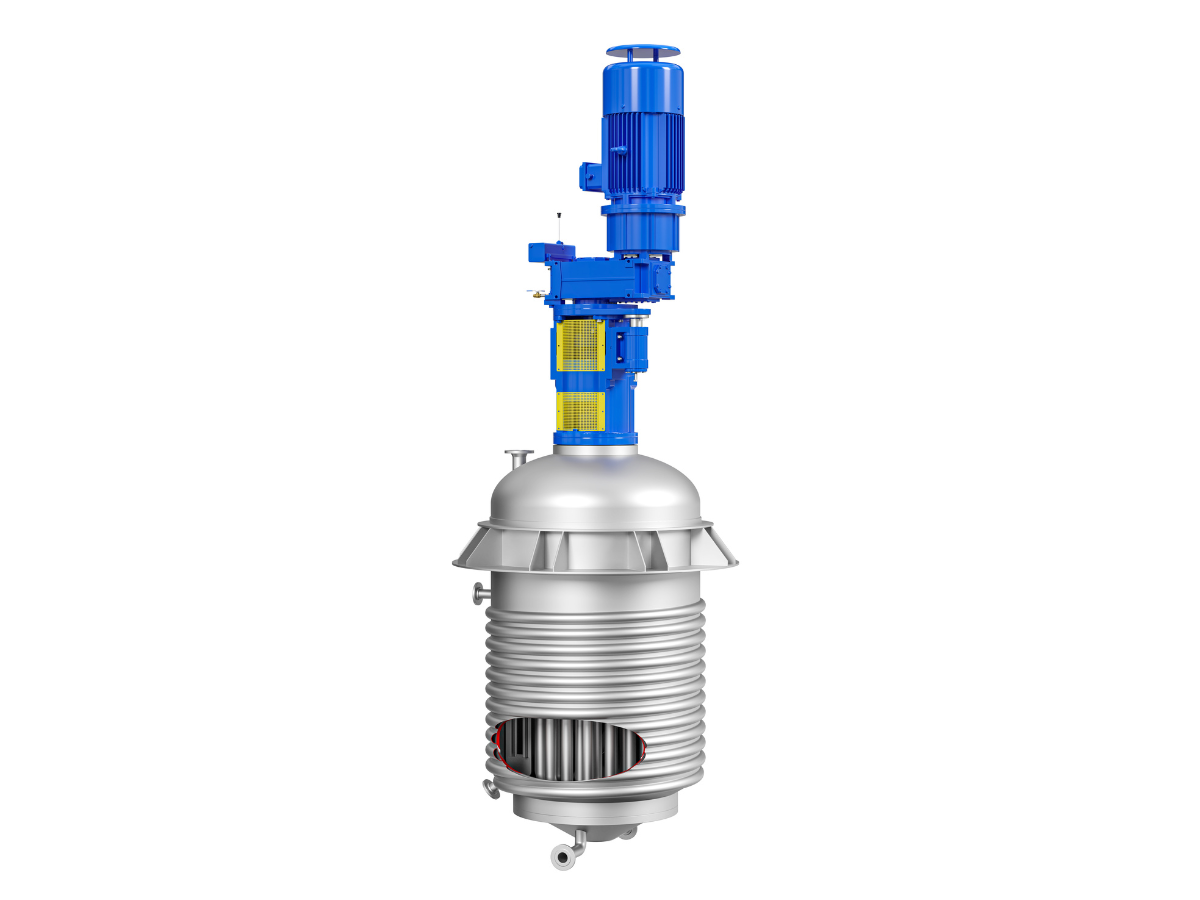
Autoclave Reactor
The primary advantage of a cage-style agitator without a central shaft is the total elimination of material "clinging" or "coring", where viscous substances stick to a central pole and fail to mix. This design ensures uniform product quality, prevents thermal degradation of stagnant material, and maximizes heat transfer efficiency by forcing all material toward the scraped cooling/heating jackets.
Design and working principle
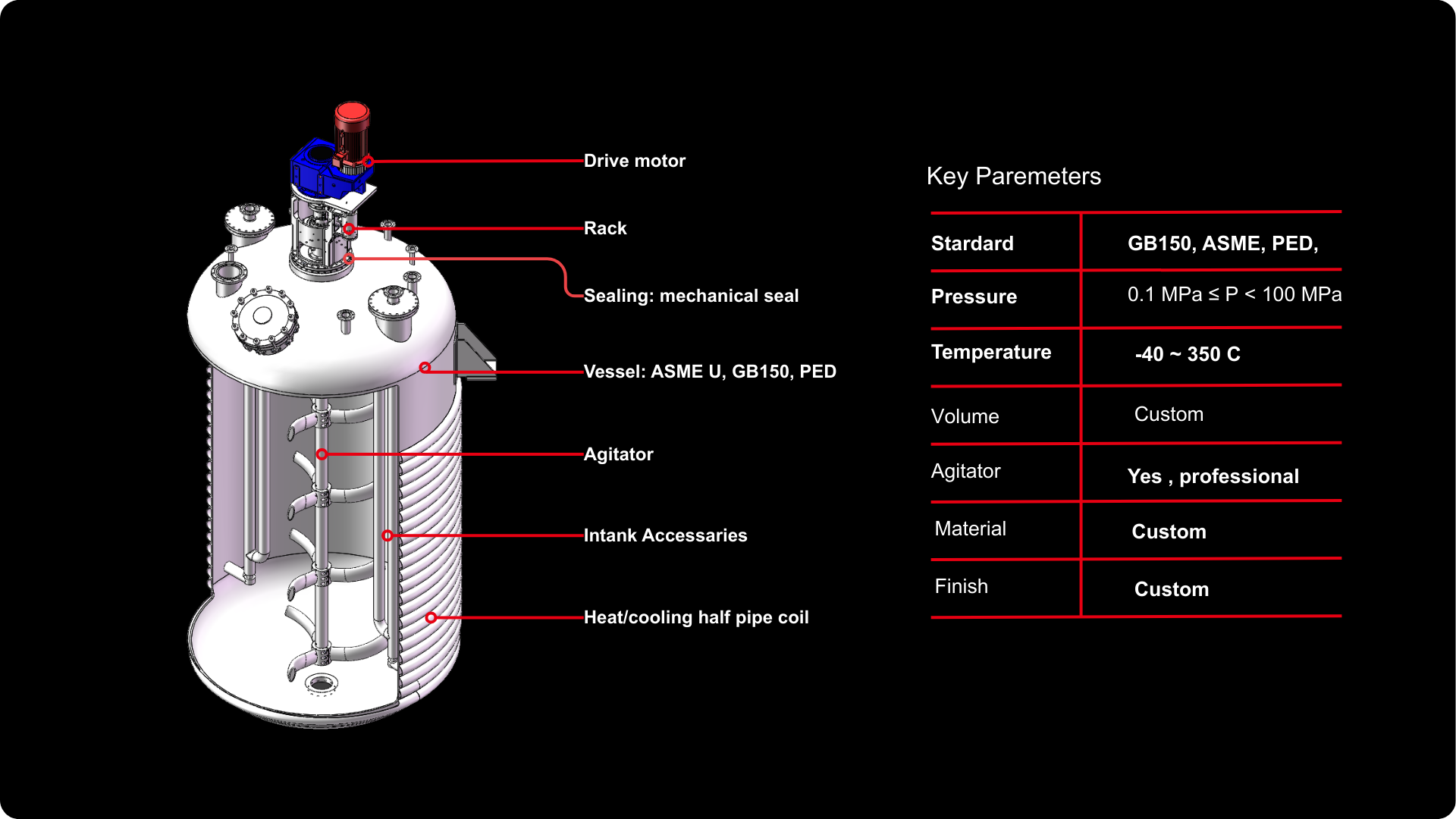
Technical data
- Operating Pressure: Typically ranges from 50 to 350 bar (5000+ psi in high-pressure models).
- Operating Temperature: Generally operates between 150°C and 500°C, though specialized units exist.
- Agitation Speed (RPM): Variable, commonly 0-300 RPM for larger vessels and up to 1500 RPM for laboratory-scale vessels.
- Reaction Time (Residence Time): Controlled based on the reaction kinetics, often 10-60 minutes for sterilization, but longer for synthesis.
- Atmosphere/Gas Input: Control of gas flow (e.g., N2, O2, H2) to manage internal environment (DO - Dissolved Oxygen).
2. Physical & Design Parameters
- Capacity/Volume: Ranges from laboratory scale (25 mL to 10 L) to industrial scale (up to 30,000+ liters).
- Material of Construction (MOC): Must withstand high stress and corrosion. Common materials include Stainless Steel (SS316L, SS304), Hastelloy (C276), Titanium, and Nickel alloys.
- Vessel Geometry: Usually cylindrical with vertical or horizontal orientation; Height to Diameter (H/D) ratio is typically around 1.5 for design efficiency.
- Heating/Cooling System: Jacket (standard, half-pipe, or limpet) or internal cooling coils for thermal control.
- Impeller/Agitator Type: Pitched blade turbines, turbines, or specialized stirrers (like Dispersimax) to ensure homogeneous mixing.
3. Critical Component Parameters
- Sealing Method: Magnetic coupling (for zero leakage) or mechanical seals are crucial for keeping the reactor sealed at high pressure.
- Safety Devices: Rupture discs, pressure safety valves, and lid interlocks to prevent accidents.
- Sensors & Controls: PID controllers for temperature, pressure transducers, liquid level sensors, and motor torque sensors.
- Impeller Location: Generally, the impeller is placed at specific distances from the bottom, such as \(1/3\) to \(1/2\) of the diameter, to maximize solid suspension.
4. Key Performance Factors
- Mass Transfer Coefficient: Crucial in gas-liquid reactions (e.g., hydrogenations) to ensure efficient reaction.
- Dead Zone Reduction: Achieved by optimizing stirrer design to prevent deposition in the bottom or low-concentration zones at the top.
- Heat Transfer Surface Area: Defined by the jacketed area to control exothermic reactions.
Specification
Structural Design Concept
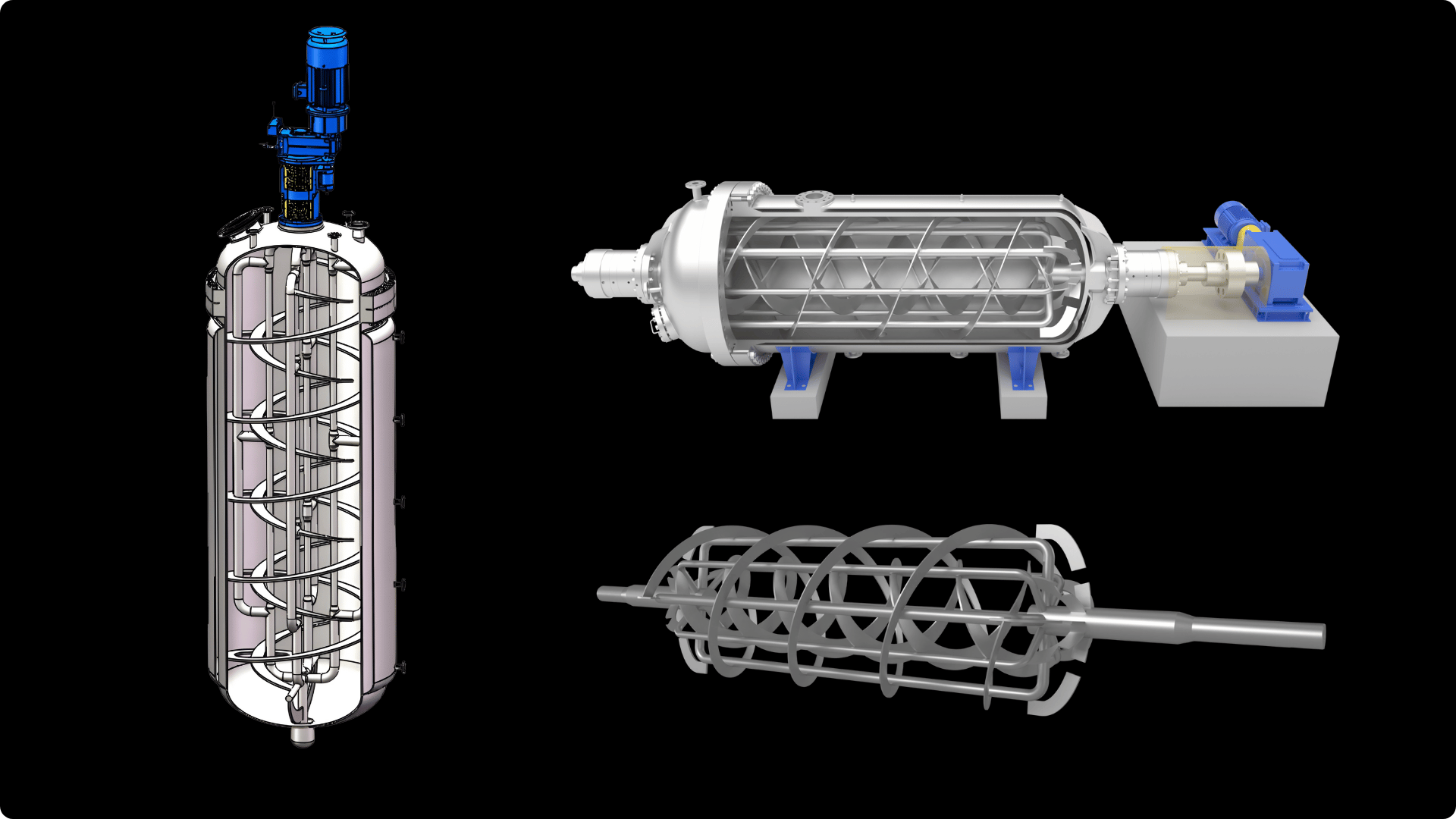
In a shaftless cage design, the mixing element is supported from the perimeter or through a reinforced outer frame connected to an offset drive. The center of the reactor remains hollow or unobstructed. This ensures that the velocity gradient is distributed toward the outer edges where the highest torque is required, rather than allowing material to "wrap" around a central pole.
Key Advantages of the Shaftless Cage
- Elimination of "Centering": In standard reactors, viscous fluids often undergo "solid-body rotation," where the material sticks to the shaft and spins with it rather than mixing. A cage design forces the material to pass through its bars, ensuring macromixing.
- Reduced Material Build-up: Since there is no central surface area, there is no place for the "glue" effect to take hold. This is critical for polymerization or food processing (e.g., caramel or dough) where stagnation leads to "hot spots" or product loss.
- Enhanced Heat Transfer: These designs are almost always paired with wall scrapers. By pushing the material from the center toward the jacketed walls and scraping it back, the system maintains a high heat transfer coefficient (
) even with thick substances.
- Lower Power Consumption: For non-Newtonian fluids, a central shaft often wastes energy moving a stagnant core. The cage design focuses energy at the high-shear zone near the vessel walls.
Related products
Explore products related to this product category.