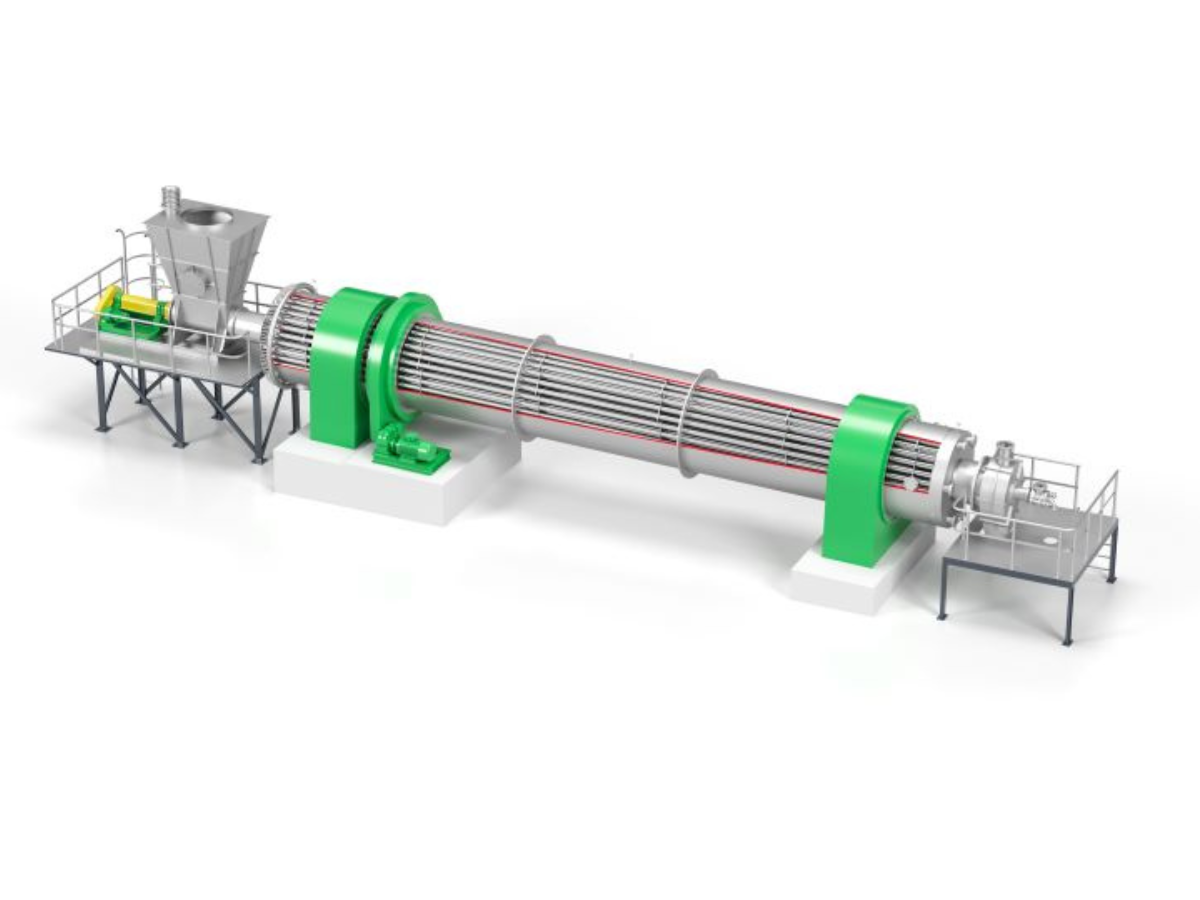
Steam Tube Dryer
A steam tube dryer is an industrial indirect-heating, rotating dryer that uses steam-filled tubes as the heat source to efficiently dry a wide variety of bulk materials.
Design and working principle
The steam tube dryer operates on the principle of indirect heat transfer (conduction), where the material being dried does not come into direct contact with the heating medium (steam).
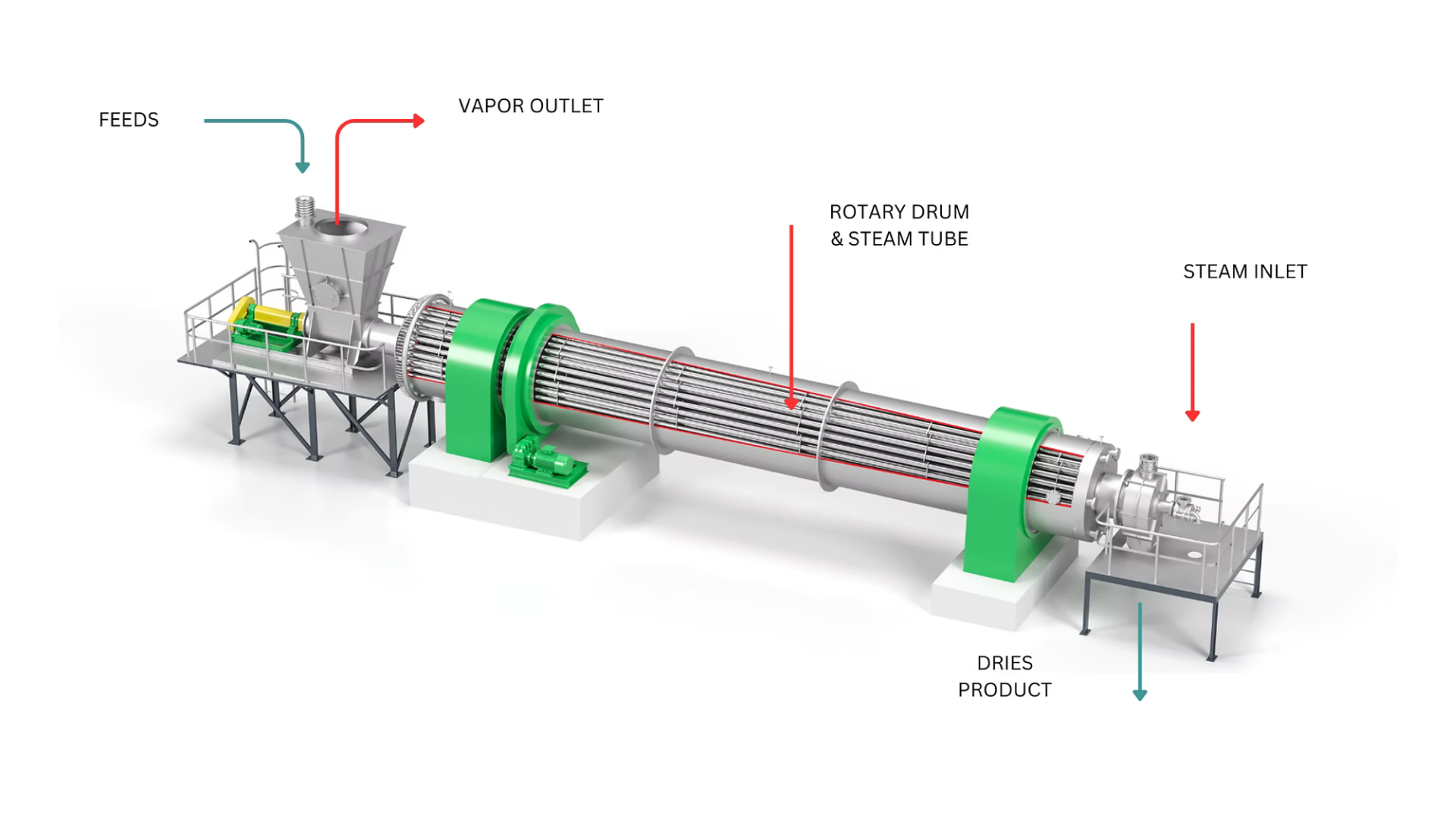
- Feeding: Raw, wet material is fed continuously into the slightly inclined, rotating cylindrical shell, often via a screw conveyor.
- Heating: Steam is introduced into a manifold at one end of the dryer and distributed into numerous tubes that run the length of the cylinder. As the material tumbles around the rotating tubes due to the shell's rotation and internal lifters/shovels, heat is transferred from the hot tube walls to the material, evaporating the moisture.
- Condensate Removal: The steam condenses as it transfers its latent heat. This condensate is continuously removed from the system through a rotary joint and returned to the boiler for regeneration, making the process highly thermally efficient.
- Discharge: The dried product moves by gravity toward the discharge end, where it exits the system.
- Vapor Handling: Only a small amount of carrier gas (sweep air) is needed to remove the evaporated moisture, minimizing exhaust gas volume and simplifying emissions control.
Technical data
- High Thermal Efficiency: Heat loss is minimal because the steam tubes are enclosed by the dryer, making it one of the most efficient types of industrial dryers.
- Gentle Drying: The material tumbles gently at lower temperatures (typically 100-180°C), which is suitable for heat-sensitive organic and inorganic materials like food products, chemicals, and biomass, as it prevents scorching or product degradation.
- Environmental & Safety Advantages: The indirect heating system results in a smaller amount of exhaust gas compared to direct-heat dryers, which reduces the size and cost of pollution control equipment. The use of steam also allows for a safer, inert processing environment for volatile materials.
- Continuous and High-Capacity Processing: The design is well-suited for continuous, large-scale industrial operations.
- Low Maintenance: With a simple and robust structure, these dryers generally require less maintenance than other models, leading to lower operating costs and a longer lifespan.
Specification
| Model | Shell Diameter mm | Shell Length mm | Heat Area m2 | Remarks |
| STD1000 | 1,000 | 12,000 | 100 | |
| STD1400 | 1,400 | 15,000 | 150 | |
| STD2000 | 2,000 | 20,000 | 300 | |
| STD2200 | 2,200 | 25,000 | 850 | |
| STD2500 | 2,500 | 28,000 | 1,200 | |
| STD3000 | 3,000 | 30,000 | 2,500 | |
| STD3400 | 3,400 | 30,000 | 2,800 | |
| STD3600 | 3,600 | 30,000 | 3,000 | |
| STD3800 | 3,800 | 30,000 | 3,200 | |
| STD4200 | 4,200 | 35,000 | 3,600 | |
| STD4500 | 4,500 | 40,000 | 4,000 |
Applications
Common Applications
Steam tube dryers are an established choice across various industries for processing a wide range of materials:
- Biomass products: Drying wood chips and other fibrous materials.
- Minerals and Ores: Processing various mineral concentrates.
- Agricultural products: Drying distillers' dried grains (DDGS), gluten feed, and oilseeds.
- Chemicals: Suitable for processing chemicals, including melamine and sodium bicarbonate, due to precise temperature control.
- Waste Sludges: Used effectively in the dewatering of industrial sludges
Related products
Explore products related to this product category.